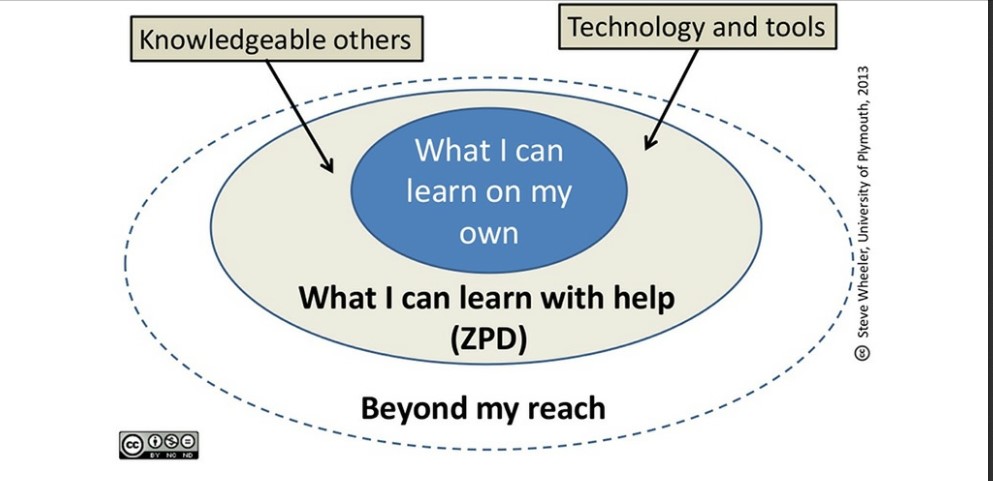
According to Vygotsky, cognitive development is reliant on culture. Vygotsky’s fundamental construct was the “zone of proximal development.” By understanding that one needs to couple knowledge and skills that students have already mastered (for example their knowledge of geography or ancient civilizations) and what they can learn and assimilate is the key to learning. It is like a train where one needs to determine what exact car the student is in and what new car they need to couple them with to complete their journey and develop new skills. The new car in this construct would be a peer or the teacher. The new peer or teacher would have to determine what stage the student was at to provide input and scaffolding for the student to progress.
Vygotsky had the principal of the More Knowledgeable Other (MKO) which was also crucial to the concept of the ZPD. In McLeod’s article, one can understand how sometimes a peer could be an MKO instead of the teacher with a task such as learning how to play a video game. Who to instruct a peer in the process of development than a peer who is already an expert in the subject matter? In our lesson plan, we utilize the guidance and encouragement of a more skilled peer as a learning tool.
In terms of implementation, we found that the best way to incorporate this aspect of development is with SPED or ELL’s. For example, one lesson involves a webquest that students would have to complete in pairs. In this scenario, the more advanced student (MKO) completes a more complicated webquest. Next, the teacher pairs the MKO with an ELL or SPED student to help them achieve a scaled-down webquest appropriate for their level. The role of the teacher is to supervise and ensure there was adequate scaffolding and facilitating for the activity to run smoothly.
Bruner explains in his concept “readiness for learning” that matters such as “interest” and “curiosity” are key aspects of learning. Seeing as how he was concerned with how teachers spark interest in concepts from the start, we decided to use tools like Webquest, Kahoot, teamwork, vidoes, intriguing opening questions, and relevant questions to spark interest in the students.
 Critical Thinking in Social Science